
How do I stop spiraling thoughts?
To stop spiraling thoughts, name the loop, pause the hunt for certainty, anchor in the present with a few sensory details, take one small next action, and park leftover worries in a short scheduled window. Spiraling thoughts feel urgent, but you can interrupt them with short, repeatable skills from Trapped Mind. This page by Jonathan walks through a practical sequence you can try the next time your mind starts spinning.
What a spiral usually looks like
A thought spiral is not the same as careful problem solving. Problem solving moves toward a decision or an action. A spiral repeats the same material with rising urgency and little new information. Common signs include:
- Replaying a conversation and inventing worse endings
- Asking what-if questions that never reach a finish line
- Searching for certainty about something that cannot be fully known yet
- Feeling more tense the longer you think, rather than clearer
- Losing track of time while stuck in the same mental scene
Noticing the pattern early is useful. You do not need to win an argument with the content of the thoughts. You need a way to step out of the loop so your attention can return to the present.
A five-step interruption sequence
Use these steps in order when you catch yourself spiraling. Keep them short. The goal is interruption, not a perfect analysis of every worry.
1. Name it without judgment
Say quietly, or write: This is a spiral. Naming puts a small gap between you and the content. You are observing the process rather than being fully pulled into every line of the story.
2. Pause the search for certainty
Spirals often feed on the hope that one more mental check will finally make you feel safe. Decide, for the next ten minutes, that you will not chase a final answer. Certainty can wait. Your job right now is to exit the loop.
3. Anchor in the body and the room
Pick three concrete details: the feel of your feet on the floor, the temperature of the air, and one object you can see clearly. Describe each detail in plain words. Sensory attention competes with rumination and helps you reorient.
4. Choose one small next action
Ask: What is one useful thing I can do in the next five minutes that is not related to solving this worry? Examples include washing a dish, stepping outside, sending a short message you already planned to send, or writing your top task for tomorrow on a sticky note. Action breaks the illusion that thinking harder is the only option.
5. Schedule a worry window if needed
If the topic truly needs attention, put it on a calendar block later today, such as a fifteen-minute worry window. Tell yourself you will revisit it then, with a pen and a clear goal. Many spirals lose intensity when they are given a container instead of free run of your evening.
Why arguing with every thought backfires
When a spiral starts, the instinct is to prove the worry wrong. Sometimes that feels briefly soothing. Often it becomes another form of rumination. Each rebuttal invites a new counter-worry. The mind stays in debate mode, and debate mode keeps attention locked on the threat story.
A more workable stance is to treat thoughts as mental events. Some are useful. Some are noisy. You can note a thought, decide whether it needs action now, and return to the present without needing a courtroom verdict. This is a self-practice skill, not a claim that thoughts never matter. It is a way to stop over-investing in loops that do not produce decisions.
A short written drill
When you have two minutes, try this on paper:
- Write the headline of the spiral in one sentence.
- Write: What I am trying to feel certain about is…
- Write: What I can actually do in the next hour is… (or write “nothing actionable right now”).
- Circle one grounding cue you will use for sixty seconds.
- Stand up and do the grounding cue, then start the one small action.
Writing externalizes the loop. Seeing it on paper often reduces the sense that the thought is the whole world. For a fuller page layout, try the spiraling thoughts worksheet.
Common obstacles
It feels irresponsible to stop thinking. Stopping a spiral is not the same as ignoring real responsibilities. You can still plan, apologize, or take action later. You are pausing unproductive looping so those actions can be clearer.
The thoughts come back within minutes. Expect that. Interrupting a habit takes repetition. Each time you notice and step out, you are practicing. Progress often looks like shorter spirals, not zero spirals overnight.
The content feels too scary to leave alone. Scary content does not automatically mean immediate danger. If there is a concrete safety issue, take real-world steps and seek appropriate help. If the content is a familiar intrusive theme with no new facts, treat it as a spiral pattern and use the sequence above. Education and self-practice tools can support you; they do not replace clinical care when you need it.
Build a personal spiral plan
Write a one-page plan you can keep on your phone:
- My early warning signs (body tension, late-night scrolling, replaying texts)
- My three grounding cues
- My default five-minute action
- My worry-window time
- People or resources I can contact if I am overwhelmed
Review the plan when you are calm so it is ready when you are not. Consistency beats intensity. A plan you actually use for two minutes is more valuable than a perfect plan you never open.
Putting it together
Spiraling thoughts thrive on urgency, certainty-seeking, and unbroken attention. You interrupt them by naming the pattern, pausing the search for a final answer, anchoring in the present, taking one small action, and giving leftover worries a scheduled container. Practice when the spiral is mild so the skills are available when it is strong.
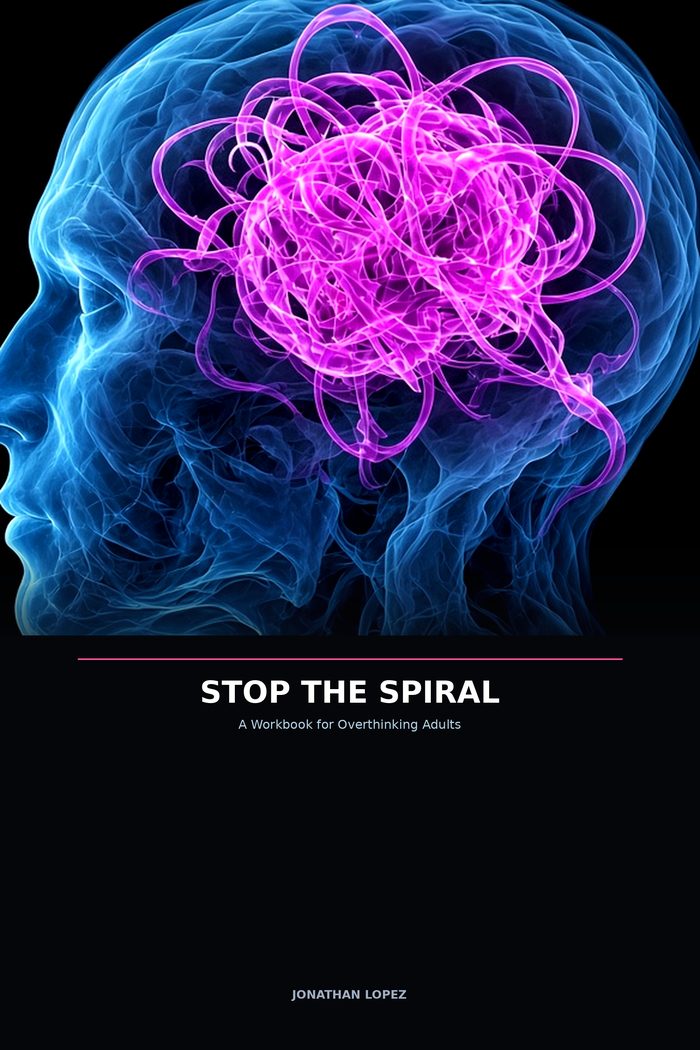
If you want a structured workbook with worksheets built around these skills, Stop the Spiral was written for adults who get stuck in overthinking loops and want something concrete to practice. See also the overthinking workbook guide for how to practice without turning the book into another perfection project.
Frequently asked questions
How do I stop spiraling thoughts?
Name the spiral, pause certainty-seeking, anchor with three sensory details, take one small next action, and schedule a short worry window if the topic still needs attention. Keep the sequence short so you exit the loop instead of analyzing it all evening.
How long does it take to interrupt a thought spiral?
A basic sequence can take a few minutes. Expect thoughts to return. Progress often looks like shorter spirals with practice, not an overnight stop to every loop.
Is stopping a spiral the same as ignoring real problems?
No. You are pausing unproductive looping so decisions and actions can be clearer. Real responsibilities can still get planning time later, including inside a worry window.
Continue with the workbook
Stop the Spiral: A Workbook for Overthinking Adults includes guided exercises for interrupting rumination and rebuilding attention. Available on Kindle.
Disclaimer: Content on Trapped Mind is for education and self-practice only. It is not therapy, diagnosis, treatment, or legal advice. If you need professional support, please consult a licensed clinician. If you are in immediate danger, contact local emergency services.